Designing a waveguide#
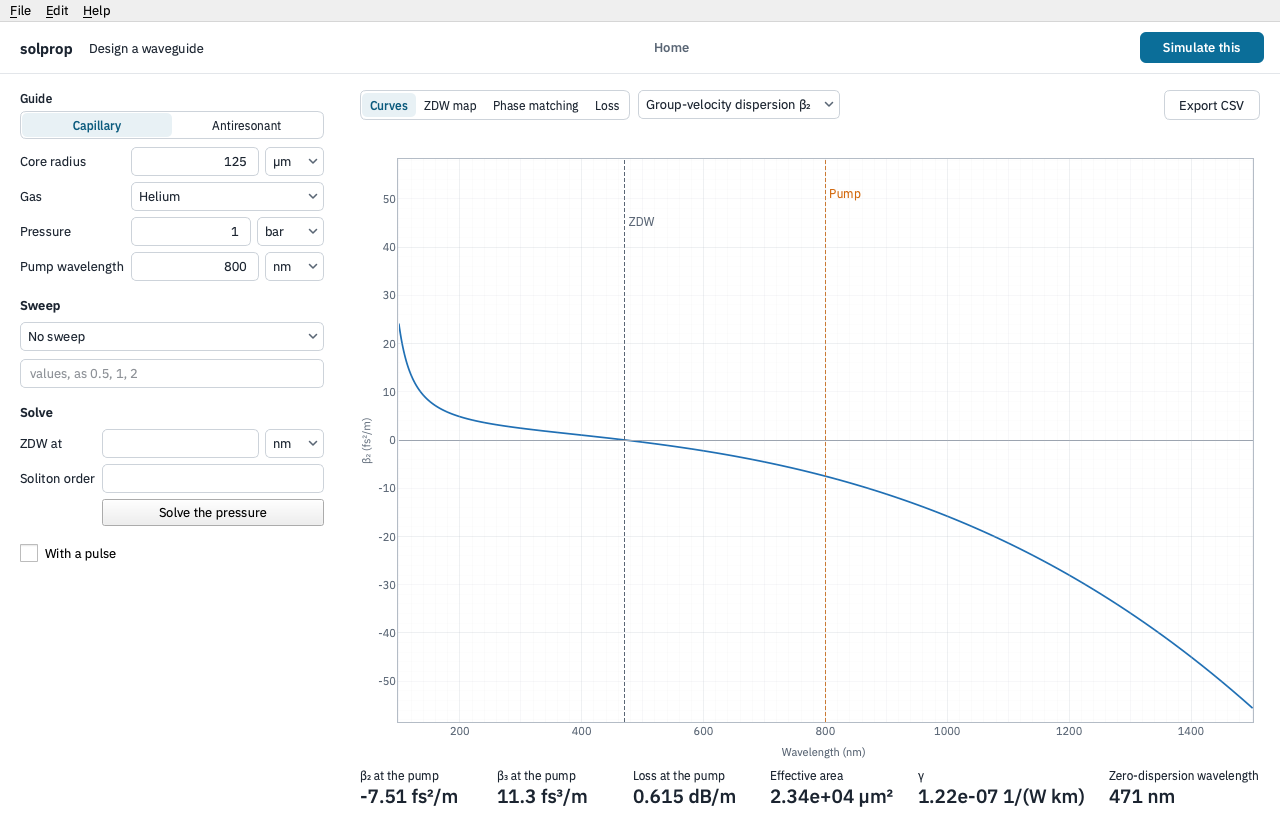
Design a waveguide, on Home, explores a gas-filled capillary or antiresonant fibre before there is a pulse or a run: which pressure puts the zero-dispersion wavelength where you want it, how the dispersion changes with the core, how much the fibre loses at the pump. It never touches the setup you have open; Simulate this carries a design to a new setup sheet when it is ready.
The guide#
Choose Capillary or Antiresonant, then the core radius, the gas, its pressure and
the pump wavelength (the antiresonant fibre adds its tubes). Every curve and number
follows as you type. The numbers below the plot are at the pump: β₂, β₃, the loss, the
effective area, γ and the zero-dispersion wavelength. They are the guide’s
own, from solprop’s mode (solprop.modes), with no pulse involved.
The pages#
Curves plots one quantity against wavelength: the group-velocity dispersion β₂, the dispersion parameter D, the third-order dispersion β₃, the effective index or the group index. The pump and the zero-dispersion wavelength are marked.
ZDW map draws, for each of several zero-dispersion wavelengths from 250 to 700 nm, the pressure that gives it against the core radius. Click a point to make that radius and pressure the design.
Phase matching plots the phase mismatch Δβ against wavelength, whose zeros are the wavelengths a dispersive wave is emitted at: the linear mismatch, or with a pulse (below), the mismatch to a soliton at the pump, which adds its nonlinear phase.
Loss plots the loss against wavelength.
Export CSV writes the plot’s curves.
Sweeps#
Sweep draws a curve for each of several values of the pressure, the core radius or the gas, so that you can compare them on one plot. Click a curve to adopt its value into the design.
Solving for a target#
Solve finds the pressure that puts the zero-dispersion wavelength where you type it (ZDW at), and with a pulse, the energy that gives a soliton order too; Solve the pressure sets them. The solve is solprop’s own, the same one a setup’s targets use.
With a pulse#
Tick With a pulse to give the pulse’s duration and energy at the pump wavelength. The numbers then add the soliton order, the peak power, the dispersion, nonlinear and fission lengths and the dispersive wave’s wavelength, and Phase matching includes the soliton’s nonlinear phase.
Simulate this#
Simulate this opens the design as a new, unsaved setup of the matching class, a capillary or an antiresonant fibre, with the design’s guide, gas and pulse written in. If the setup you have open has unsaved changes, the window asks first.